
British citizenship by descent for children born in the U.S.

«British by descent» is the label for someone who got citizenship through a parent rather than by being born or naturalized in the UK. It matters because that person usually cannot pass citizenship on automatically to their own children born abroad.
Are you already British?
For a child born outside the UK on or after 1 July 2006, gov.uk says citizenship is automatic if a parent was a British citizen at the birth and could pass it on (apply for citizenship if you have a British parent).
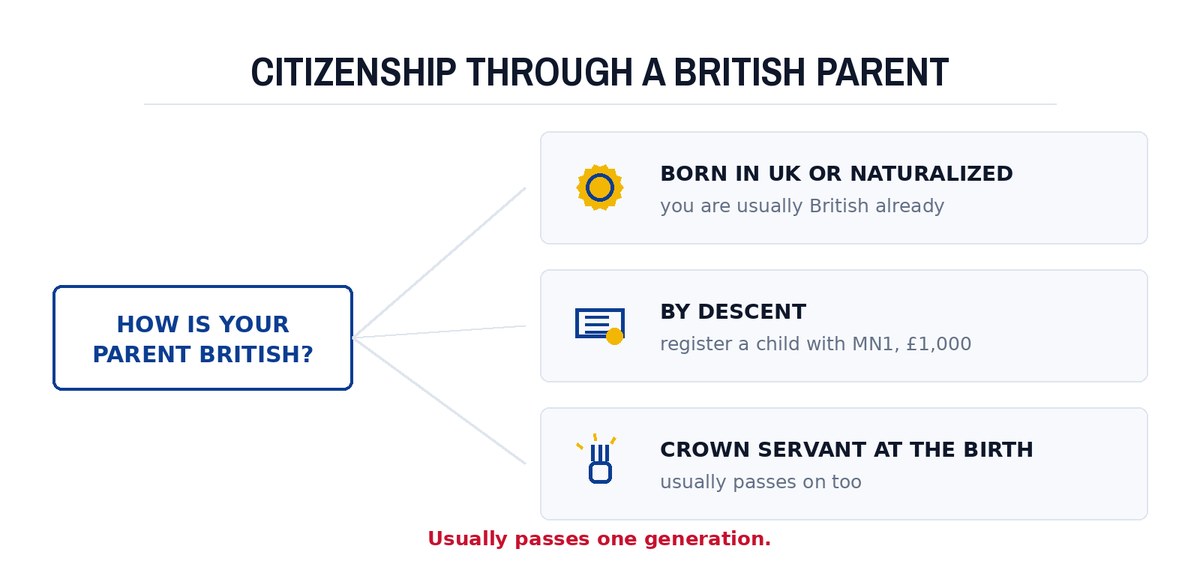
A parent can pass it on if they were born or adopted in the UK, became a citizen in their own right, or were working as a Crown servant at the time.
| Born | Automatic if | Otherwise |
|---|---|---|
| On or after 1 July 2006 | A parent was British and could pass it on | Register a child with MN1 |
| 1 January 1983 to 30 June 2006 | Same, and parents married if only the father was British | UKF route if your British father was not married to your mother |
| Before 1 January 1983 | Your father was British, married to your mother and could pass it on | UKF or UKM, depending on the parent |
If you are automatically British, there is nothing to apply for. You can go straight to a first passport, or ask the Home Office for a letter confirming your status.
Registering a child who is not automatically British
A child under 18 may be registered when the British parent is British by descent but lived in the UK for at least 3 years before the birth, with no more than 270 days abroad in that time, and that parent's own parent could pass citizenship on.
Another route is for a child who has lived in the UK with the parents for the 3 years before applying.
The fee for registering a child is £1,000, down from £1,214 in the Home Office fees table since 8 April 2026. You apply online with form MN1 and you are asked to give biometric information; the application tells you where.
A grandparent born in the UK is not enough on its own: the parent's 3 years in the UK before the birth is what usually opens the MN1 route.Adults and the citizenship ceremony
Adults who register attend a citizenship ceremony, with a £130 fee added to the application. gov.uk's pages for the UKF and UKM routes give that £130 as the fee. In the U.S., gov.uk lists a citizenship ceremony service at the Embassy in Washington, New York and Miami.
Proving it once you are British
The Home Office does not keep a record of everyone who is British automatically, so the proof is a British passport, or a letter confirming your status.
That letter, a «Status Letter (Nationality)», costs £489 in the Home Office fees table. A passport costs less than the letter and is the document a British citizen shows at the UK border; see our dual citizenship guide for the alternatives.
gov.uk's checker, «Check if you have British citizenship», walks through the dates and the parents' status if you are unsure which row of the table applies.