
Apostilles for UK and U.S. documents

An apostille is the stamp that lets a public document from one Hague Convention country be accepted in another. What decides it is where the document was issued.
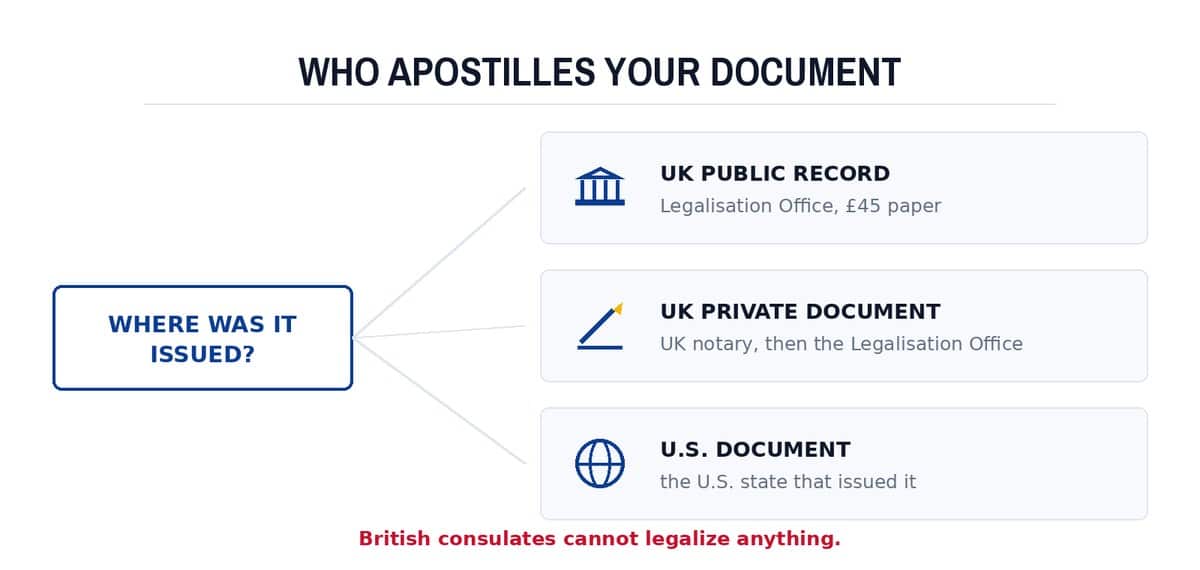
Which office apostilles what
| Document | Who apostilles it |
|---|---|
| UK public document: GRO certificate, court paper, UK government letter | FCDO Legalisation Office |
| UK private document: contract, power of attorney, copy of a passport | A UK notary or solicitor first, then the Legalisation Office |
| U.S. document for use in the UK | The authorities of the U.S. state that issued it |
The FCDO is clear on the last row: you cannot get documents issued outside the UK legalized through its service; you get them legalized in the country that issued them (documents for British people abroad).
Fees and times at the Legalisation Office
A paper apostille costs £45 per document plus courier, and returning documents to the U.S. costs £42 per 1.5kg. An e-Apostille costs £35 and is for PDFs signed electronically by a UK notary or solicitor, according to gov.uk.
The standard paper service usually takes up to 25 working days plus courier; the e-Apostille, up to 2 working days. Fees are not refunded if a document cannot be legalized.
GRO certificates and ACRO police certificates can only get a paper apostille.Documents that cannot be e-Apostilled
The electronic route excludes birth, death, marriage, civil partnership and adoption certificates and anything else from the General Register Office, ACRO police certificates, DBS certificates, disclosure certificates for Scotland and Northern Ireland, and fingerprint certificates.
For those, you send the paper document.
If the document needs certifying first, the FCDO says that has to be done by a notary or solicitor based in the UK; a U.S. notary does not count for this step.
Which UK documents can be apostilled
The Legalisation Office checks signatures, stamps and seals against its own records.
It accepts documents issued by a court with a wet ink seal, by a public registry such as the General Register Office or Companies House, by a government department and signed by an official, or by a registered doctor (the Legalisation Office page on gov.uk).
Other documents qualify once a UK public official, such as a UK notary or solicitor, has certified them. That covers a power of attorney, a contract, a qualification certificate, or a copy of a passport or driving license.
The FCDO links official lists of notaries and solicitors for England and Wales, Scotland and Northern Ireland.
After a paper application you are told how to send the documents, and they come back by courier or post. An e-Apostille arrives by email and can be downloaded as many times as you need and shared digitally. Faster paper services, next day for £40 and same day for £100, are only for registered businesses.