
Signature Certificate, the inkan replacement
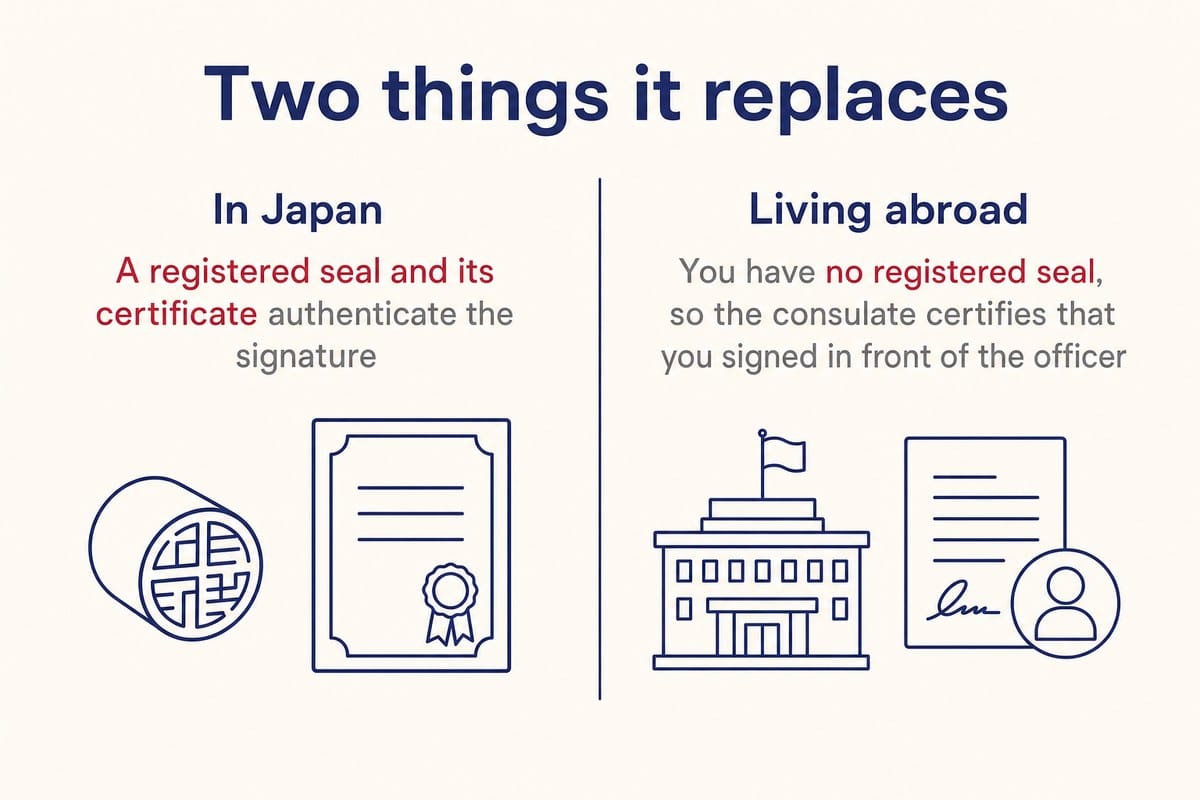
In Japan, a registered seal and its certificate authenticate a signature on anything that matters: an inheritance distribution, a property transfer, a sworn statement, a contract with a public body. Someone living abroad has no registered seal, and the signature certificate takes its place.
What it is used for
Why it has to be in person
The certificate says that the officer watched you sign. That is the whole content of the document, and it is why nobody can do it for you.
Bring the document, not a copy
The consulate certifies your signature on a specific document, so bring the document itself, unsigned. Signing beforehand defeats the purpose and the officer will ask you to start again.
Some offices issue a certificate with a fingerprint alongside the signature, which is what certain Japanese institutions require. Ask the receiving institution which form it needs before you book.
What to prepare beforehand
Ask the institution in Japan for the exact form it requires. Some accept the consulate's standard certificate. Others supply their own document to be signed in front of the officer, and a few require a fingerprint alongside the signature.
Bringing the wrong form means a second appointment, and at several consulates the next slot is weeks away.Inheritance files
An estate divided in Japan usually needs a signature certificate from every heir, alongside a certificate of residence and often several generations of family register. Collecting all of that from heirs scattered across two countries is the slow part of a Japanese inheritance.
For non-Japanese nationals
Some consular certificates are available only to Japanese nationals or former nationals. Others, including certain signature certifications, are available more widely. If you are not Japanese and a Japanese institution has asked you for one, contact the office before you travel to it.