
Registering a marriage abroad
Registering a marriage through a Japanese consulate turns a U.S. certificate into an entry on the Japanese family register. Anything that follows from being married in Japanese terms, from a spouse visa to inheritance, depends on that entry.
What you file
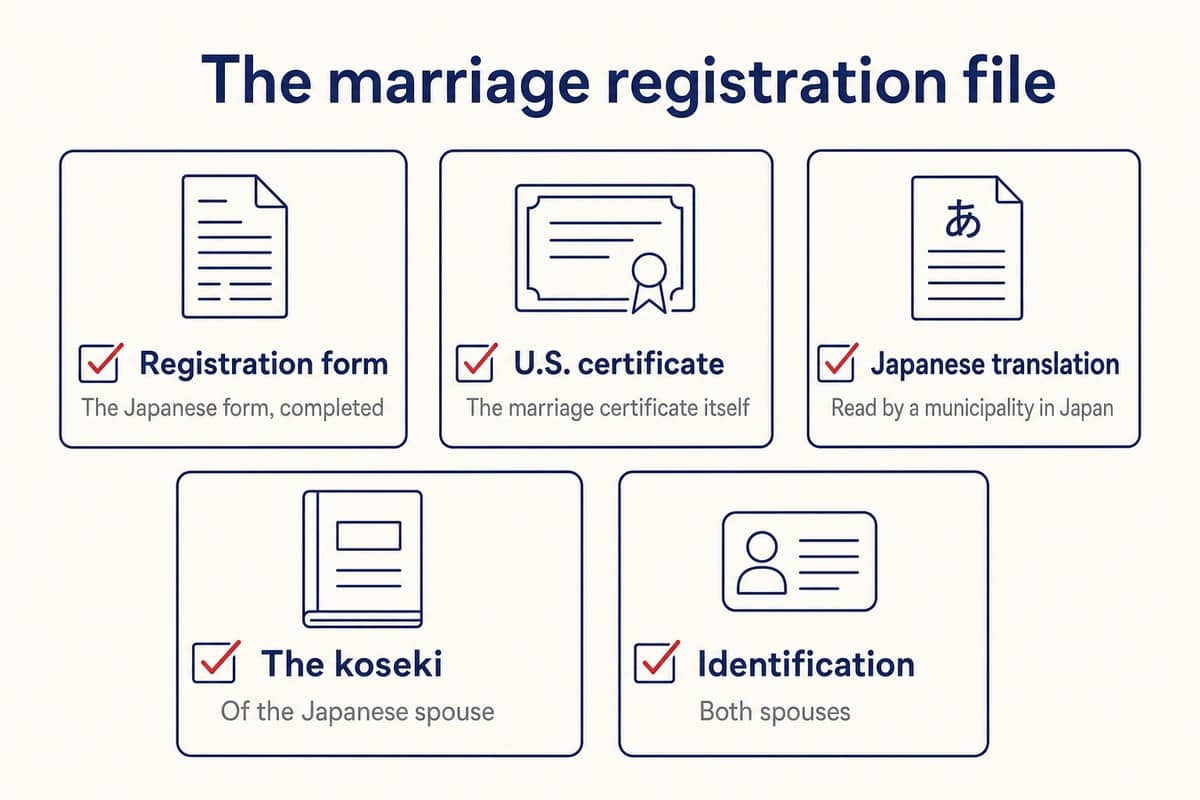
Names
A marriage between a Japanese national and a foreign national does not automatically change either name on the register. Changing it is a separate filing, with its own deadline after the marriage, and it is worth deciding before you file rather than after.
Divorce, and death
Divorces finalised in the United States are registered the same way, with the decree and a translation. Deaths of Japanese nationals abroad are also registered through the consulate, and that filing has a short deadline.
Filing in Japan instead
The registration can also be filed directly with the municipality of the registered domicile in Japan, by post or by a relative. That route is sometimes faster than going through a consulate, and it is worth asking about if the nearest office is a long drive.
What the marriage unlocks
A marriage on the register is the basis for a spouse visa, for inheritance rights, and for a change of surname. None of those can proceed on a U.S. certificate alone.
If a spouse visa is the goal, file the marriage registration first and count the month it takes to appear. The Certificate of Eligibility application in Japan will ask for the koseki showing the marriage.Deaths
The death of a Japanese national abroad is reported through the consulate, and the deadline is short. The file needs the U.S. death certificate with a translation and the deceased's passport. It is the filing families are least prepared for, and the office will walk you through it.